On This Page
You installed solar panels expecting summer to be your best season. More sunlight, longer days, bigger electricity bills to offset — it seems logical that April and May should produce the most power. But when you check your inverter app, the numbers tell a different story. Your daily generation in May is actually lower than what you produced in February or March.
You are not imagining things, and your system is probably not faulty. This is one of the most counter-intuitive facts about solar energy: more sun does not always mean more power. In the extreme heat of a Tamil Nadu summer, your panels can lose 15–20% of their rated output — and understanding why this happens is the first step to managing it.
The Counter-Intuitive Truth: Heat is the Enemy of Solar Panels
Solar panels are rated under Standard Test Conditions (STC), which assume a panel temperature of 25°C and irradiance of 1000 W/m². These are laboratory conditions. In the real world — particularly on a rooftop in Coimbatore, Madurai, or Chennai during April — panel surface temperatures routinely reach 60–70°C.
Here is the fundamental physics: solar cells are semiconductors. As temperature rises, the electrons in the silicon become more agitated, which reduces the voltage the cell can produce. While current increases slightly with temperature, the voltage drop is far larger, resulting in a net loss of power output.
This is not a defect. It is how every crystalline silicon solar panel on the planet behaves. The question is not whether your panels lose output in heat — it is how much they lose and what you can do about it.
Temperature Coefficient: The Number That Matters
Every solar panel has a specification called the temperature coefficient of Pmax, expressed as a percentage per degree Celsius. This tells you how much power output decreases for every degree the panel temperature rises above 25°C.
Typical temperature coefficients:
- Polycrystalline panels: -0.40% to -0.45% per °C
- Mono-PERC panels: -0.35% to -0.40% per °C
- Premium monocrystalline (HJT/TOPCon): -0.26% to -0.30% per °C
What This Means in Practice
Consider a 540W Mono-PERC panel with a temperature coefficient of -0.38%/°C. On an April afternoon in Coimbatore, the panel surface temperature reaches 65°C.
- Temperature above STC: 65°C - 25°C = 40°C
- Power loss: 40 × 0.38% = 15.2%
- Actual output: 540W × (1 - 0.152) = 458W
That panel rated at 540W is only producing 458W — a loss of 82W per panel. On a 3kW system with 6 panels, that is nearly 500W of lost capacity during peak afternoon hours.
On the very hottest days, when panel temperatures touch 70°C or above (common on flat concrete roofs with poor ventilation), losses can exceed 17–20%.
Tamil Nadu Summer: What Happens to Your Panels Month by Month
Tamil Nadu's solar generation follows a predictable seasonal pattern that surprises many system owners. Here is what a typical 3kW on-grid system in Coimbatore produces across the year:
Monthly Generation for a 3kW System in Coimbatore (kWh)
| Month | Avg Daily (kWh) | Monthly Total (kWh) | Notes |
|---|---|---|---|
| January | 11.5 | 356 | Cool, clear skies |
| February | 12.8 | 358 | Increasing irradiance, still cool |
| March | 13.5 | 419 | Peak generation month |
| April | 12.2 | 366 | Heat starts reducing output |
| May | 11.8 | 366 | Extreme heat, 15–20% loss |
| June | 10.5 | 315 | Southwest monsoon onset, cloud cover |
| July | 9.8 | 304 | Monsoon continues |
| August | 10.2 | 316 | Partial clearing |
| September | 10.8 | 324 | Retreating monsoon |
| October | 9.5 | 295 | Northeast monsoon, heavy rains in Chennai |
| November | 9.0 | 270 | Peak northeast monsoon |
| December | 10.2 | 316 | Monsoon retreating, shorter days |
| Annual | 4,005 | Average for Coimbatore |
Key insight: March is typically the best month — high irradiance combined with moderate temperatures. By April-May, even though sunlight hours are longer, the heat penalty drags down total generation. Then the monsoon months (June-July and October-November) bring cloud cover losses.
For Chennai, the pattern shifts slightly: October-November losses are more severe due to the northeast monsoon, while summer heat losses are compounded by coastal humidity.
Mono-PERC vs Polycrystalline: Temperature Performance Compared
If you are choosing panels for a new installation — or evaluating whether to upgrade — temperature performance should be a key factor in Tamil Nadu's climate.
Head-to-Head Comparison at 65°C Panel Temperature
| Parameter | Polycrystalline 335W | Mono-PERC 540W |
|---|---|---|
| Temp coefficient | -0.43%/°C | -0.37%/°C |
| Power loss at 65°C | 17.2% | 14.8% |
| Actual output | 277W | 460W |
| Loss per panel | 58W | 80W (but higher base) |
| Efficiency retention | 82.8% | 85.2% |
Mono-PERC panels retain a higher percentage of their rated output in heat. Over a full Tamil Nadu summer (March through May), this translates to approximately 5–8% more annual generation compared to polycrystalline panels of equivalent capacity.
Newer technologies like HJT (Heterojunction) and TOPCon panels push this advantage further with temperature coefficients as low as -0.26%/°C. While they cost 10–15% more, they can be worth the premium in consistently hot climates like Tamil Nadu.
How to Minimize Heat Loss: Practical Steps
You cannot change the weather, but you can reduce how much heat affects your system.
1. Ensure Proper Ventilation Gap Under Panels
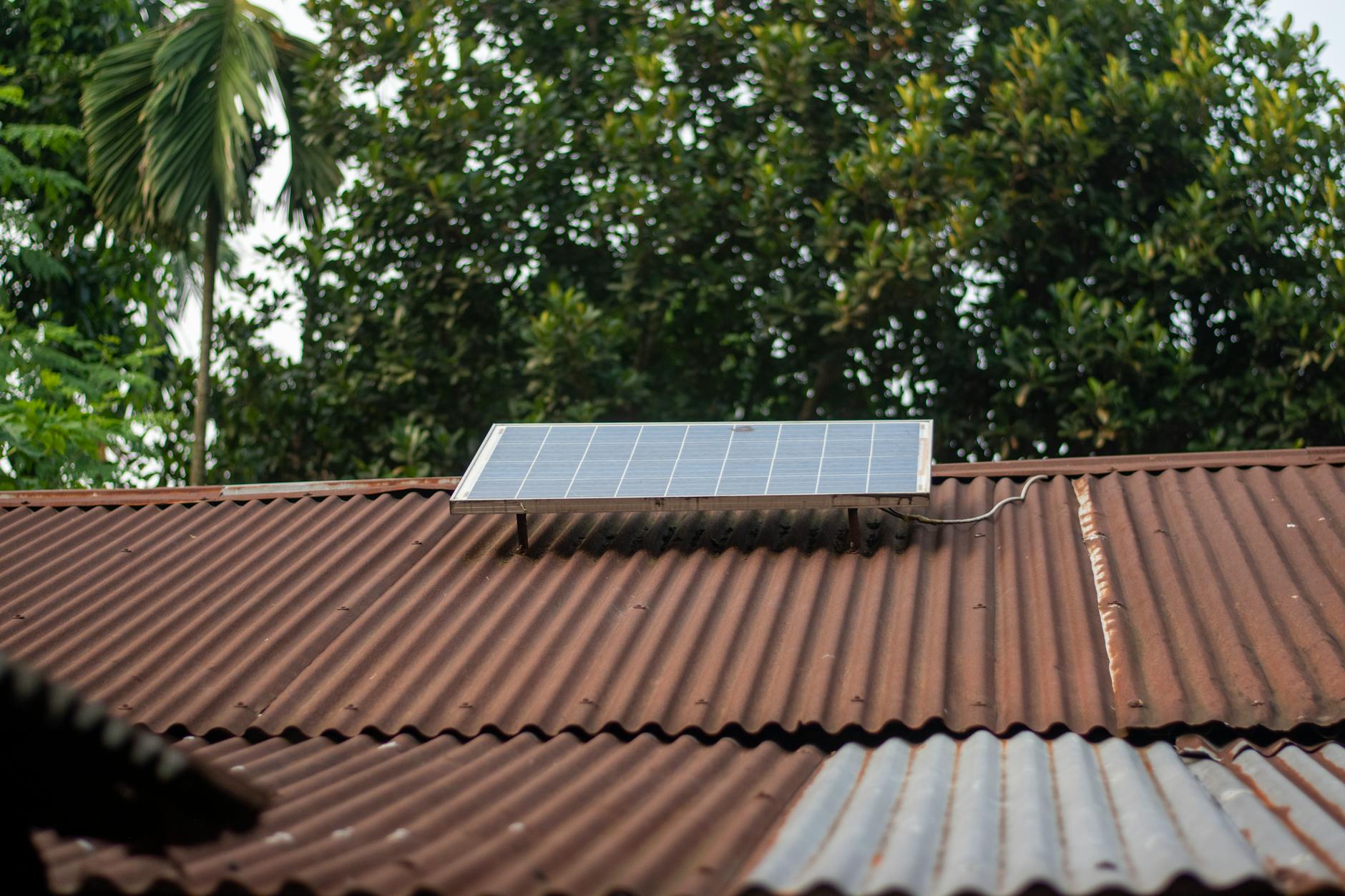
This is the single most impactful factor. Panels mounted flat against a roof surface (or on a flat concrete terrace with minimal tilt) trap heat between the panel backsheet and the roof. This can increase panel temperature by an additional 10–15°C compared to well-ventilated installations.
Best practice: Maintain a minimum 150mm (6-inch) gap between the panel backsheet and the roof surface. Tilted mounting structures naturally create this gap. If your panels are on a flat roof with ground-mount structures, ensure the lowest edge is at least 300mm above the surface.
2. Choose Panels with Low Temperature Coefficients
When comparing panel options, look at the temperature coefficient on the datasheet — not just the wattage or price per watt. A panel with -0.35%/°C will outperform one with -0.45%/°C by a meaningful margin over its 25-year lifetime in Tamil Nadu.
3. Clean Panels Early in the Morning
Cleaning your panels at 6:30–7:00 AM, before the sun heats them up, serves two purposes. First, cool water on a hot panel can cause thermal shock and micro-cracks — early morning cleaning avoids this risk. Second, clean panels start the day at maximum efficiency before heat builds up.
4. Monitor Generation via Your Inverter App
Apps like Solis Cloud, Growatt ShinePhone, or Goodwe SEMS let you track daily and hourly generation. Establish your baseline for each month in the first year. If May generation drops more than 20% compared to March, investigate whether there is an additional issue beyond normal heat loss.
5. Consider Light-Colored Roofing
Dark-colored roofs absorb more heat, which radiates upward into the panels. If you are building new or re-roofing, light-colored or reflective roof coatings can reduce ambient temperature around your panels by 5–8°C.
Inverter Clipping in Extreme Heat
There is another subtle effect that compounds heat losses: inverter clipping. Many residential systems are designed with a DC-to-AC ratio greater than 1.0 — meaning the panel capacity exceeds the inverter capacity. For example, 3.3kW of panels connected to a 3kW inverter.
Under normal conditions, this overloading maximizes generation during morning and evening hours. But on extremely hot days, when you might expect the inverter to handle reduced panel output easily, a different problem can occur.
Some inverters reduce their own output capacity (de-rate) when internal temperatures exceed their operating threshold — typically 45–50°C for the internal electronics. If your inverter is installed in direct sunlight or in a poorly ventilated enclosure, it may de-rate by 10–20% on top of the panel losses.
Solution: Ensure your inverter is installed in a shaded, ventilated location. A simple shade structure or north-facing wall mount can prevent inverter de-rating entirely.
When to Worry vs Normal Seasonal Variation
Not every generation dip indicates a problem. Here is a practical guide:
Normal (Do Not Worry)
- 10–15% lower generation in May compared to March
- Gradual decline from March peak through monsoon months
- Generation recovering in January-February
- Day-to-day variation of 10–20% due to passing clouds
Investigate Further
- More than 25% drop from expected monthly generation
- Sudden drop (not gradual seasonal change)
- One string producing significantly less than another
- Generation not recovering after monsoon ends
- Inverter showing error codes or frequent restarts
Call Your Installer Immediately
- Zero generation on a sunny day
- Inverter displaying fault codes repeatedly
- Burning smell or discoloration on any component
- Physical damage to panels (cracks, browning, delamination)
Real-World Tips from Tamil Nadu Installations
After installing 500+ systems across Tamil Nadu, here is what we have learned about managing summer heat:
- Elevated structures outperform flush mounts by 8–12% in summer months due to better airflow
- West-facing panels suffer more heat loss than south-facing ones because they receive peak sun during the hottest afternoon hours
- Micro-inverter systems handle heat better than string inverters because panel-level optimization prevents one hot panel from dragging down the entire string
- Annual generation matters more than any single month — do not panic about May numbers if your annual total meets projections
The Bottom Line
Summer heat degradation is a normal, well-understood phenomenon that every solar system in Tamil Nadu experiences. A well-designed system accounts for this in its generation projections. If your installer promised you specific annual generation numbers and your system is meeting those targets, your system is performing exactly as it should — even if individual summer months seem disappointing.
The key is to focus on annual generation, ensure proper ventilation and cleaning, and monitor trends rather than obsessing over daily numbers.
Want to know what your system should be generating for your specific location and setup? Use our solar savings calculator to get location-specific projections that account for seasonal variation, or contact our team for a detailed performance analysis of your existing system.
Tristar Green Energy Solutions has been installing and maintaining solar systems across Tamil Nadu since 2013. We design every system with Tamil Nadu's specific climate conditions in mind — including summer heat degradation — so your actual generation matches our projections.
Ready to Go Solar?
Get a personalized solar quote based on your electricity consumption and roof area.
Related Articles
Solar Panels During Cyclone Season: Protection Guide for Coastal TN
Living on Tamil Nadu's coast means cyclone preparedness is essential. Learn how to protect your solar panels during cyclone season, what wind ratings matter, and insurance considerations.
Solar Panel Recycling & End-of-Life Rules in India (2026 Guide)
Your solar panels carry a 25-year warranty, but what happens to them after that? CPCB's new e-waste guidelines put take-back responsibility on manufacturers. Here's what Tamil Nadu homeowners and businesses should know — and ask their installer — before buying.
Tamil Nadu Solar Tariff & Subsidy Tracker 2026 (Updated)
One reference page for every number that matters: current TNERC electricity tariff orders, PM Surya Ghar subsidy slabs, GST rate, net metering caps, and national disbursement stats — sourced, dated, and kept current.