On This Page
Tamil Nadu has 1,076 km of coastline stretching from Pulicat Lake in the north to Kanyakumari in the south. For the millions of residents and businesses in coastal districts, rooftop solar is an excellent investment — but it comes with a challenge that inland installations don't face: salt-air corrosion.
The humid, salt-laden marine air that blows in from the Bay of Bengal and the Indian Ocean accelerates metal degradation, attacks electrical connections, and can significantly shorten the lifespan of solar system components if not addressed proactively. This guide covers the specific maintenance requirements for coastal solar installations in Tamil Nadu and the standards Tristar follows to ensure 25-year performance in these harsh environments.
The Coastal Challenge: Why Salt Air Is the Enemy of Solar Systems
Salt spray and marine aerosols travel surprisingly far inland. While the worst corrosion occurs within 500 meters of the shoreline, measurable salt-air effects extend up to 5–10 km inland depending on wind patterns and building density.
Affected Coastal Areas in Tamil Nadu
| District | Key Coastal Towns | Corrosion Severity |
|---|---|---|
| Chennai | Besant Nagar, Thiruvanmiyur, Ennore, Royapuram | Moderate to High |
| Tuticorin (Thoothukudi) | Harbour area, Meelavittan, Kayalpattinam | High |
| Ramanathapuram | Rameswaram, Mandapam, Keelakarai | Very High |
| Nagapattinam | Nagapattinam town, Velankanni, Kodiyakarai | High |
| Cuddalore | Cuddalore port area, Porto Novo | Moderate to High |
| Kanyakumari | Kanyakumari town, Colachel, Muttom | High |
| Tiruvallur | Ennore, Pulicat | Moderate |
Installations within 2 km of the coast fall in the C4-C5 corrosion category (ISO 12944), which demands marine-grade materials and enhanced maintenance protocols.
Components Most at Risk
Not all parts of a solar system corrode equally. Here's a risk assessment by component:
1. Mounting Structure (Highest Risk)
The mounting structure is exposed 24/7 to the elements and bears the mechanical load of the panels. Standard mild steel (MS) or basic galvanized iron (GI) structures can show visible rust within 2–3 years in coastal environments.
Failure mode: Rust weakens structural joints, bolt connections loosen, and in extreme cases, frames can collapse under wind load during cyclone season.
2. Junction Boxes and MC4 Connectors (High Risk)
The junction box on the rear of each solar panel contains bypass diodes and wiring connections. MC4 connectors link panels in series. Both are susceptible to:
- Salt crystal accumulation on contact points
- Corrosion of copper/tin contacts leading to increased resistance
- Micro-arcing at corroded connections, creating hot spots
- Seal degradation allowing moisture ingress
3. Cable Trays and Conduits (Moderate Risk)
GI cable trays and conduit pipes corrode from the outside in. Once the protective coating fails, rust progresses rapidly in salt air.
4. Inverter Housing (Moderate Risk)
Outdoor-rated inverters have IP65/IP66 enclosures, but salt deposits can clog ventilation filters, causing overheating and reduced efficiency.
5. Panel Frames (Low Risk)
Solar panel frames are made of anodized aluminum, which naturally resists corrosion. However, the junction between aluminum frames and steel mounting structures can create galvanic corrosion — where dissimilar metals in contact accelerate each other's degradation.
Anti-Corrosion Mounting: Material Selection Guide
The mounting structure is where material selection has the greatest impact on system longevity.
Material Comparison for Coastal Installations
| Material | Corrosion Resistance (Coastal) | Expected Life (Coastal) | Cost Premium | Recommendation |
|---|---|---|---|---|
| Mild Steel (MS) painted | Poor | 3–5 years | Baseline | Not recommended |
| Hot-dip galvanized (HDG) steel | Moderate | 10–15 years | +15% | Minimum acceptable |
| HDG steel + powder coating | Good | 15–20 years | +25% | Good for 2–5 km from coast |
| Anodized aluminum (6063-T5) | Excellent | 25+ years | +40% | Best for < 2 km from coast |
| Marine-grade stainless steel (SS 316) | Excellent | 25+ years | +80% | For severe marine environments |
| HDG + zinc-aluminum-magnesium (ZAM) | Very Good | 20–25 years | +30% | Excellent cost-performance balance |
Tristar's recommendation: For installations within 5 km of Tamil Nadu's coastline, we use anodized aluminum (6063-T5) mounting structures as standard. For installations between 5–10 km from the coast, HDG steel with duplex coating (galvanizing + powder coat) provides adequate protection at a lower cost.
Fastener Selection
Fasteners (bolts, nuts, washers) are often overlooked but are the first point of failure in coastal environments.
- Stainless steel 316 (A4-grade) fasteners are mandatory for coastal installations
- Nylon isolation washers should be used between aluminum and steel joints to prevent galvanic corrosion
- Anti-seize compound applied to all threaded connections prevents salt-induced seizure
Panel Cleaning: Coastal-Specific Protocol
Cleaning Frequency
| Distance from Coast | Recommended Cleaning Frequency | Reason |
|---|---|---|
| Less than 1 km | Every 2 weeks | Heavy salt deposits, marine bird droppings |
| 1–3 km | Monthly | Moderate salt accumulation |
| 3–5 km | Monthly | Light salt + dust combined |
| 5–10 km | Bi-monthly (every 6–8 weeks) | Minimal salt, standard dust |
In coastal Chennai (Besant Nagar, ECR, Thiruvanmiyur, OMR south), monthly cleaning is recommended. In areas like Adyar, T. Nagar, or Anna Nagar (8+ km from coast), bi-monthly cleaning suffices.
Water Quality for Cleaning
This is critical and often ignored. Using hard water (high TDS bore well water) for panel cleaning leaves mineral deposits that are nearly as damaging as the salt you're trying to remove.
- Best: RO/DI water or collected rainwater
- Acceptable: Municipal tap water (CMWSSB supply, TDS < 500 ppm)
- Avoid: Bore well water (TDS > 1,000 ppm), sea water (obviously)
A simple TDS meter (₹500) can help you check your water source. If your only available water is high-TDS bore water, use a final rinse with RO water to prevent mineral scaling.
Cleaning Method
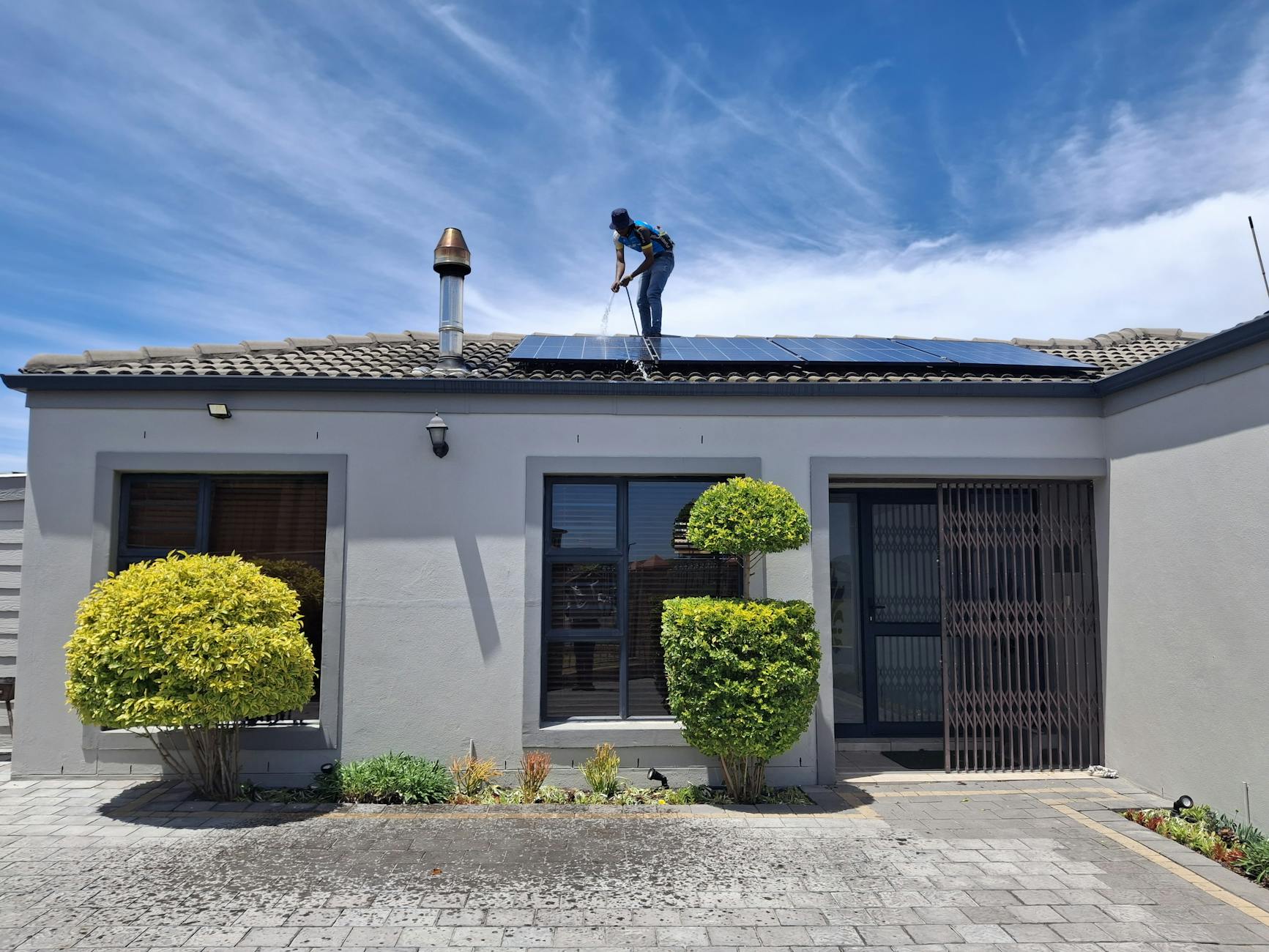
- Rinse panels with clean water to remove loose salt and dust
- Apply mild, pH-neutral cleaning solution (or plain water if cleaning frequently)
- Use a soft brush or microfiber mop — never abrasive scrubbers
- Rinse thoroughly, ensuring no soap residue remains
- Clean early morning (before 9 AM) or late evening — never when panels are hot, as thermal shock can cause micro-cracks
Junction Box and Connector Inspection Checklist
Perform this inspection every 6 months for coastal installations (annually for inland):
- Check all MC4 connectors for tightness — they should not pull apart by hand
- Inspect MC4 connector metal contacts for green/white corrosion deposits
- Verify junction box seals are intact — no visible gaps or cracks
- Check for water ingress signs inside junction boxes (condensation, staining)
- Measure string voltages — uneven readings may indicate corroded connections
- Inspect cable insulation for cracking or UV degradation
- Check earth bonding connections for continuity
- Verify cable gland seals on inverter/distribution box entries
- Apply dielectric grease to accessible connection points
- Re-torque any loose fasteners on junction boxes
Pro tip: Use a thermal imaging camera (or hire a service with one) to scan all connections annually. Hot spots at connectors indicate increased resistance from corrosion — catching these early prevents panel damage and fire risk.
Inverter Placement in Coastal Environments
Outdoor vs Indoor Placement
| Factor | Outdoor | Indoor |
|---|---|---|
| Salt exposure | Direct | Minimal |
| Ventilation filter clogging | Frequent | Rare |
| Lifespan impact | Reduces by 2–3 years | No impact |
| Maintenance need | Higher (quarterly filter cleaning) | Standard |
| Installation cost | Lower (no dedicated room) | Higher (ventilated room needed) |
| Recommendation (coastal) | Avoid if possible | Strongly preferred |
For coastal installations, Tristar recommends placing inverters in a ventilated indoor space — a utility room, garage, or dedicated electrical room. If outdoor installation is unavoidable:
- Use an IP66-rated inverter (not just IP65)
- Install a protective canopy/shade structure
- Clean ventilation filters monthly
- Apply conformal coating to inverter PCBs during installation (some manufacturers offer this as a factory option)
Annual Maintenance Schedule for Coastal Installations
| Month | Task | Duration | Who |
|---|---|---|---|
| January | Full system inspection + thermal imaging | 2–3 hours | Tristar technician |
| February | Panel cleaning | 1 hour | Owner/cleaner |
| March | Panel cleaning + connector check | 1.5 hours | Owner/technician |
| April | Panel cleaning | 1 hour | Owner/cleaner |
| May | Panel cleaning + inverter filter clean | 1.5 hours | Owner/cleaner |
| June | Panel cleaning (pre-monsoon) | 1 hour | Owner/cleaner |
| July | Full system inspection (post-cyclone season prep) | 2–3 hours | Tristar technician |
| August | Panel cleaning | 1 hour | Owner/cleaner |
| September | Panel cleaning + mounting structure check | 1.5 hours | Owner/technician |
| October | Panel cleaning | 1 hour | Owner/cleaner |
| November | Post-monsoon inspection + cleaning | 2 hours | Tristar technician |
| December | Panel cleaning + year-end performance review | 1.5 hours | Owner/Tristar |
Estimated annual maintenance cost (coastal): ₹8,000–₹15,000 for a residential system (3–10 kW), including professional inspections and cleaning supplies. This is approximately 30–40% higher than inland maintenance costs but is essential to protect your investment.
Warranty Considerations: Does Salt Corrosion Void Your Warranty?
This is a common concern among coastal solar system owners. The answer depends on the component and manufacturer.
Panel Warranty
Most tier-1 solar panel manufacturers (Adani, Tata, Waaree, Jinko, Canadian Solar) offer a 25-year performance warranty that covers manufacturing defects. Salt corrosion of the panel frame is generally not covered as it's considered an environmental factor. However:
- If corrosion causes delamination or affects cell performance, the performance warranty may still apply
- Panels with IEC 61701 (salt mist corrosion) certification are tested for coastal conditions — always ask for this certification for coastal projects
Inverter Warranty
Standard inverter warranties (5–10 years) typically include clauses about operating environment. Installing an outdoor-rated inverter outdoors doesn't void warranty, but neglecting filter maintenance in a corrosive environment may.
Key takeaway: Proper maintenance documentation (cleaning logs, inspection reports) strengthens your warranty claim position. Tristar provides digital maintenance logs for all AMC customers.
Mounting Structure Warranty
Mounting structure warranties (10–15 years) are where material choice directly determines coverage. A standard GI structure warranty may explicitly exclude coastal environments, while an aluminum structure warranty is more comprehensive.
Tristar's Coastal Installation Standards
For every coastal installation in Tamil Nadu, Tristar Energy follows enhanced standards beyond the typical MNRE specifications:
- Mounting: Anodized aluminum 6063-T5 (within 5 km) or duplex-coated HDG steel (5–10 km)
- Fasteners: SS 316 (A4) throughout, with nylon isolation at dissimilar metal joints
- Connectors: Marine-rated MC4 connectors with UV-resistant boots
- Cables: Double-insulated, UV-resistant DC cables with marine-grade glands
- Inverter: Indoor placement strongly recommended; IP66 minimum for outdoor
- Cable management: UV-resistant cable ties replaced annually; SS cable trays
- Earth bonding: Enhanced earthing system with additional corrosion-resistant earth rods
- Documentation: Coastal installation-specific maintenance guide provided to every customer
Coastal AMC (Annual Maintenance Contract)
Tristar offers a specialized Coastal AMC that includes:
- 3 professional inspections per year (vs 2 for inland)
- Annual thermal imaging scan
- Inverter filter cleaning (quarterly for outdoor units)
- Mounting structure corrosion spot-check with touch-up treatment
- Priority response for post-cyclone damage assessment
Contact Tristar for a coastal solar installation assessment or calculate your coastal solar savings.
Final Thought
Coastal locations in Tamil Nadu receive excellent solar irradiation — often 4.5–5.0 kWh/m2/day, among the best in the state. The corrosion challenge is real but entirely manageable with the right materials, installation practices, and maintenance discipline. Don't let salt air deter you from going solar — just make sure your installer knows how to build for the coast.
Ready to Go Solar?
Get a personalized solar quote based on your electricity consumption and roof area.
Related Articles
Solar Maintenance Checklist | Tristar 25-Year Guide
A well-maintained solar system generates 15-20% more energy over its lifetime than a neglected one. Follow Tristar's comprehensive maintenance framework — monthly, quarterly, and annual tasks — to ensure your system delivers peak performance for 25 years.
Solar Panels During Cyclone Season: Protection Guide for Coastal TN
Living on Tamil Nadu's coast means cyclone preparedness is essential. Learn how to protect your solar panels during cyclone season, what wind ratings matter, and insurance considerations.
Solar Inverter Noise: Fan vs Electrical Faults Guide
Strange sounds from your solar inverter can indicate anything from a dusty fan to a serious electrical fault. Learn to identify normal vs abnormal inverter noises, common error codes, and when to call a professional.