 Back to Blog
Solar Panel Cleaning: Can You Use Hard Water in Coimbatore/Chennai?
On This Page
It is cleaning day for your solar panels. You drag out the garden hose, spray down the panels with bore water, and feel good about maintaining your system. A week later, you notice white streaks and spots on the glass that were not there before. Your generation numbers have dipped slightly. You clean again with the same bore water, and the spots get worse.
If you live in Coimbatore, Chennai, or most of Tamil Nadu's inland cities, you have likely just discovered the hard water problem — and you are not alone. It is one of the most common and least discussed maintenance issues for rooftop solar systems in South India.
Bore water in Coimbatore typically measures 300–500 TDS (Total Dissolved Solids), with some areas exceeding 700 TDS. In Chennai, neighborhoods like Porur, Ambattur, Avadi, and Poonamallee routinely see bore water above 500 TDS. When this mineral-rich water dries on your solar panel glass, it leaves behind calcium carbonate, magnesium, and silica deposits that form a white, hazy film — and that film blocks sunlight from reaching the solar cells underneath.
Understanding the Hard Water Problem
What Exactly Is in Your Bore Water?
The "hardness" in bore water comes from dissolved minerals picked up as groundwater moves through limestone, chalk, and dolomite rock formations. In Tamil Nadu, the primary contaminants are:
- Calcium carbonate (CaCO3): The main culprit behind white scaling. Coimbatore's bore water is particularly high in calcium due to the limestone formations in the Western Ghats foothills.
- Magnesium: Contributes to overall hardness and leaves a dull residue.
- Silica (SiO2): Forms an extremely hard, glass-like deposit that is almost impossible to remove without specialized chemicals. Common in Chennai bore water.
- Iron: Leaves reddish-brown stains. More common in bore water from deeper wells.
TDS Levels Across Tamil Nadu
| Location | Typical Bore Water TDS | Hardness Level |
|---|---|---|
| Coimbatore (Peelamedu, Singanallur) | 350–500 | Hard |
| Coimbatore (Saravanampatti, Kalapatti) | 400–600 | Very Hard |
| Chennai (Porur, Ambattur) | 500–800 | Very Hard |
| Chennai (Avadi, Poonamallee) | 500–700 | Very Hard |
| Chennai (Adyar, Besant Nagar) | 200–350 | Moderately Hard |
| Chennai (Anna Nagar, T. Nagar) | 250–400 | Hard |
| Madurai | 300–500 | Hard |
| Tiruchirappalli | 250–450 | Hard |
| Salem | 200–400 | Moderately Hard |
| Erode | 350–550 | Very Hard |
Reference: Water below 150 TDS is considered soft. Above 300 TDS is hard. Above 500 TDS is very hard.
What Happens When Hard Water Dries on Solar Panels
When you spray bore water on your panels and let it evaporate in the Tamil Nadu sun, the water disappears but the minerals stay behind. Here is the progression:
First Few Cleanings
Barely noticeable. A faint white haze may be visible at certain angles but does not significantly affect generation. Most system owners do not notice anything wrong at this stage.
After 3–6 Months of Hard Water Cleaning
A visible white film builds up, particularly at the edges of the panel where water pools before dripping off. The film is uneven — thicker where water sat longest. Generation may drop 3–5% compared to a clean panel.
After 1–2 Years of Hard Water Cleaning
The mineral deposits have bonded chemically to the glass surface. The panels have a permanent cloudy or milky appearance that does not wash off with plain water. Generation loss reaches 8–15%. At this point, the deposits may be so hard that only chemical treatment or professional cleaning can restore the panels.
The Compounding Effect
Here is the math that makes this problem urgent:
- A 3kW system in Coimbatore generates approximately 4,000 kWh annually
- At ₹6/unit (average TANGEDCO rate for 400+ unit consumers), that is ₹24,000/year in savings
- 10% generation loss from mineral deposits = ₹2,400/year in lost savings
- Over 25 years: ₹60,000 in lost generation from a problem that costs ₹200–500/year to prevent
Hard Water vs Soft Water Cleaning: The Difference
Hard Water Cleaning (What NOT to Do)
Process: Spray bore water on panels, let it air dry in the sun.
Result after 6 months: Visible white mineral deposits across the panel surface. The deposits are concentrated at panel edges and in any low spots where water pools. Under magnification, the deposits appear as a rough, crystalline layer bonded to the glass.
Generation impact: 5–10% loss after 6 months, increasing to 10–15% after 1–2 years.
Soft Water Cleaning (Best Practice)
Process: Clean with RO water or rainwater, squeegee dry immediately.
Result after 6 months: Panel glass remains clear and transparent. No mineral buildup. The anti-reflective coating on the glass remains intact and functional.
Generation impact: Less than 1% loss (only from micro-scratching if cleaning technique is poor).
The difference is dramatic and cumulative. Two identical panels on the same roof — one cleaned with bore water and one with RO water — can show a 10–15% generation gap within a year.
Solutions: Ranked from Best to Acceptable
Best: RO Water or Collected Rainwater
RO (Reverse Osmosis) water has TDS below 50 — essentially mineral-free. It leaves no residue when it evaporates on the panel surface.
How to implement:
- If you have a household RO system, collect the purified water in a separate tank for panel cleaning
- A typical 3kW system (6 panels) needs approximately 30–40 liters of water per cleaning session
- At 10 liters/hour from a home RO unit, you need 3–4 hours of collection before cleaning day
Rainwater is nature's distilled water with TDS typically below 30. If you have a rainwater harvesting tank, this is an excellent and free source of cleaning water.
Practical tip for Coimbatore: Many homes in RS Puram, Race Course, and Peelamedu already have RO systems for drinking water. Ask your system to be set up with a separate tap for collecting RO water — most plumbers can add this for ₹500–1,000.
Good: Tap Water + Immediate Squeegee Drying
If RO water is not available in sufficient quantities, tap water (Coimbatore corporation water is typically 150–250 TDS — much better than bore water) can be used if you follow one critical rule: do not let it air dry.
Method:
- Wet the panel surface with tap water using a soft hose (no high pressure)
- Immediately wipe with a soft, lint-free cloth or sponge
- Squeegee the entire surface from top to bottom, overlapping strokes
- Ensure no standing water remains on the panel surface
The key is removing the water before minerals can deposit on the glass. If you squeegee within 60 seconds of wetting, mineral buildup is minimal.
Acceptable: Soft Cloth Wipe After Tap Water
If you do not have a squeegee, you can use a soft microfiber cloth to wipe panels dry after wetting with tap water. This is less effective than a squeegee because cloth fibers can leave micro-scratches over time, but it is far better than air drying.
Important: Use a dedicated cloth for panel cleaning only. Do not use the same cloth you use for other cleaning — embedded grit can scratch the glass.
Never: Pressure Washer
Do not use a pressure washer on solar panels. This is worth stating emphatically because it is a common mistake.
Pressure washers (even at low settings) can:
- Damage the anti-reflective coating on the glass surface, permanently reducing generation by 2–3%
- Force water into the panel frame seals, causing moisture ingress that leads to PID (Potential Induced Degradation) and cell corrosion
- Crack junction box seals, allowing water into electrical connections
- Damage MC4 connectors if water is directed at cable connections
A gentle garden hose with a standard nozzle provides more than enough water pressure for panel cleaning.
Cleaning Frequency by Location
How often you need to clean depends on your specific environment. Dust, pollution, bird droppings, pollen, and proximity to construction all affect soiling rates.
Coimbatore: Every 3–4 Weeks
Coimbatore has moderate dust levels but low rainfall outside the monsoon months. The industrial areas (Singanallur, SIDCO, Peelamedu industrial estates) have higher particulate matter, requiring more frequent cleaning.
- Industrial/commercial areas: Every 2–3 weeks
- Residential areas: Every 3–4 weeks
- During construction nearby: Weekly
Chennai: Every 2–3 Weeks
Chennai's coastal environment adds salt spray to the equation, along with higher pollution levels and humidity that causes dust to stick rather than blow off.
- Coastal areas (ECR, OMR, Thiruvanmiyur): Every 2 weeks (salt deposits accelerate corrosion)
- Industrial areas (Ambattur, Guindy): Every 2 weeks
- Central residential (Anna Nagar, Adyar): Every 3 weeks
- Suburban (Tambaram, Chromepet): Every 3–4 weeks
Rural Tamil Nadu: Monthly
Rural installations benefit from cleaner air but may have seasonal issues:
- Harvest season: Dust from agricultural activity may require additional cleaning
- Near unpaved roads: Every 2–3 weeks
- Near poultry farms: Bird droppings require spot cleaning as needed
Post-Monsoon: Additional Cleaning
After the northeast monsoon (October-December) and southwest monsoon (June-September), panels often have a layer of dried mud and debris. A thorough post-monsoon cleaning should be scheduled regardless of your regular schedule.
DIY Cleaning Method: Step by Step
Follow this method for safe, effective panel cleaning:
Equipment Needed
- Garden hose with gentle nozzle (no pressure washer)
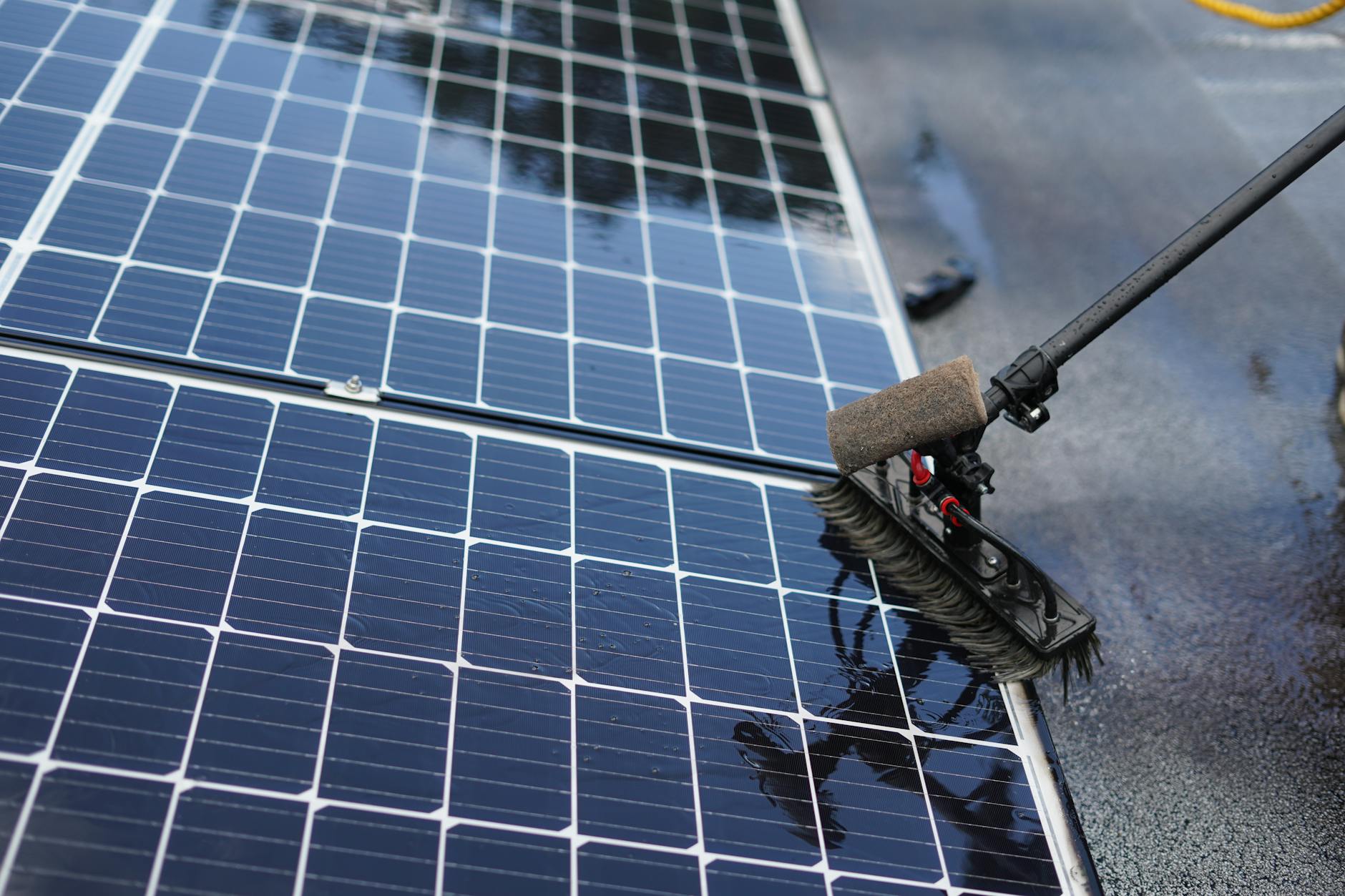
- Soft sponge or microfiber mop with extension handle
- Rubber-blade squeegee with extension handle
- Bucket of RO water or clean tap water
- Soft, lint-free microfiber cloths
Timing
Clean early morning (6:30–7:30 AM) or late evening (after 5:30 PM).
Never clean panels during the heat of the day for two reasons:
- Cold water on hot glass can cause thermal stress and micro-cracking
- Water evaporates almost instantly in the Tamil Nadu midday sun, defeating the purpose
Procedure
Step 1: Safety first. If your panels are on a sloped roof, do not climb onto the roof unless you have proper fall protection. Use extension-handle tools from the ground or from a safe elevated position. For flat concrete terraces, ensure the surface is dry and non-slippery before walking near panels.
Step 2: Rinse with water. Use the garden hose to gently rinse the entire panel surface, starting from the top and working down. This removes loose dust and debris. Let the water flow for 30–60 seconds per panel.
Step 3: Gentle scrub. Using the soft sponge or microfiber mop, gently wipe the panel surface in straight lines from top to bottom. Do not press hard — let the sponge do the work. For stubborn spots (bird droppings, tree sap), let the water soak for 2–3 minutes before wiping.
Step 4: Final rinse. Rinse the panel with clean water (ideally RO water) to remove any remaining soap or loosened grime.
Step 5: Squeegee dry (critical for hard water areas). Immediately squeegee the panel surface from top to bottom in overlapping strokes. Do not leave any standing water. This single step prevents 90% of hard water mineral buildup.
Step 6: Inspect. Look at the panel surface from an angle (the way you would check a car windshield for spots). Any remaining spots can be addressed with a damp microfiber cloth.
What NOT to Do
- Do not use abrasive sponges, steel wool, or rough cloths
- Do not use detergent, soap, or household cleaners (they leave residue and can damage the anti-reflective coating)
- Do not stand or lean on panels
- Do not clean during rain with lightning (obvious but worth stating)
- Do not use bore water for the final rinse — if you must use bore water for the initial rinse, use RO water for the final rinse and squeegee immediately
When to Invest in Automatic Cleaning Systems
For larger systems (5kW and above) or situations where manual cleaning is difficult (high roofs, elderly homeowners, commercial buildings), automatic cleaning systems can be a worthwhile investment.
Robotic Panel Cleaners
Motorized robots that travel along the panel surface on rails, using soft brushes to clean without water. Cost: ₹15,000–40,000 depending on system size.
Pros: No water needed, eliminates hard water problem entirely, can run on a schedule Cons: Higher upfront cost, requires installation of guide rails, brush replacement every 1–2 years
Spray Systems
Automated water spray systems with timer-controlled nozzles mounted along the panel edges. Cost: ₹8,000–20,000.
Pros: Low maintenance, automated scheduling Cons: Still requires clean water supply (must be connected to RO or rainwater tank to avoid hard water issues), water consumption
Self-Cleaning Coatings
Hydrophobic nano-coatings applied to the panel surface that cause water to bead up and roll off, carrying dust with it. Cost: ₹1,500–3,000 per application (lasts 1–2 years).
Pros: Reduces cleaning frequency by 50%, panels stay cleaner between manual cleanings Cons: Needs reapplication, does not eliminate cleaning entirely, effectiveness reduces over time
Cost of Professional Cleaning Service
If you prefer not to clean panels yourself, professional cleaning services are available across Tamil Nadu:
| System Size | Per-Cleaning Cost | Recommended Frequency | Annual Cost |
|---|---|---|---|
| 1–3 kW | ₹300–500 | Monthly | ₹3,600–6,000 |
| 3–5 kW | ₹500–800 | Monthly | ₹6,000–9,600 |
| 5–10 kW | ₹800–1,500 | Bi-weekly to monthly | ₹10,000–18,000 |
| 10–50 kW (commercial) | ₹1,500–5,000 | Bi-weekly | ₹36,000–1,20,000 |
Tristar's AMC (Annual Maintenance Contract) includes panel cleaning as part of the package, along with inverter inspection, connection tightening, and performance monitoring. This is the most cost-effective approach for residential systems.
Impact on Generation: The Numbers
Here is real-world data from our installations showing the impact of panel soiling and cleaning method:
3kW System in Coimbatore — Monthly Generation Comparison
| Condition | Daily Generation (kWh) | Monthly (kWh) | vs Clean Baseline |
|---|---|---|---|
| Clean panels (just cleaned) | 13.2 | 396 | Baseline |
| 2 weeks without cleaning | 12.5 | 375 | -5.3% |
| 4 weeks without cleaning | 11.9 | 357 | -9.8% |
| Hard water deposits (6 months) | 11.2 | 336 | -15.2% |
| Bird droppings (partial shading) | 10.5 | 315 | -20.5% |
The 15.2% loss from hard water deposits translates to approximately 720 kWh per year — worth ₹4,320 at ₹6/unit. Over the 25-year life of the system, that is ₹1,08,000 in lost generation from a completely preventable problem.
Before and After Professional Cleaning
Systems that have been neglected for 6 months or more with hard water cleaning show immediate improvement after professional treatment:
- Average generation recovery: 12–18%
- Time to see improvement: Immediate (next sunny day)
- Cost of professional deep cleaning: ₹1,500–3,000 (one-time, includes chemical treatment for mineral deposits)
Removing Existing Hard Water Deposits
If your panels already have mineral buildup from months of bore water cleaning, here is how to address it:
Mild Deposits (Less Than 6 Months)
A solution of white vinegar and RO water (1:3 ratio) applied with a soft cloth can dissolve light calcium carbonate deposits. Apply, let sit for 5 minutes, gently wipe, rinse with clean water, and squeegee dry.
Caution: Do not use vinegar on hot panels. Clean in early morning only.
Heavy Deposits (6+ Months)
Professional cleaning with specialized solar panel cleaning solutions is recommended. These solutions contain mild acids that dissolve mineral deposits without damaging the panel glass or anti-reflective coating. Do not use bathroom descalers, hydrochloric acid, or any abrasive chemicals — they will permanently damage the panel surface.
The Bottom Line
Hard water is the silent enemy of solar panels in Coimbatore and Chennai. The fix is simple and inexpensive — use clean water and do not let it air dry — but ignoring it costs thousands of rupees in lost generation over your system's lifetime.
If you are planning a new solar installation, ask your vendor about cleaning recommendations for your specific water quality. If you have an existing system with visible mineral deposits, a professional cleaning can restore your generation immediately.
Need help with panel maintenance or want to set up an AMC for your solar system? Contact our team for a maintenance consultation. Or use our solar savings calculator to see how much clean panels could improve your annual returns.
Tristar Green Energy Solutions provides installation and maintenance services for solar systems across Tamil Nadu. Our AMC packages include regular panel cleaning with RO water, ensuring your panels maintain peak generation throughout their lifetime.
Ready to Go Solar?
Get a personalized solar quote based on your electricity consumption and roof area.
Related Articles
Solar Maintenance | Coastal TN Salt-Air Corrosion
Protecting your solar investment from salt-air corrosion along Tamil Nadu's 1,076 km coastline — material selection, maintenance schedules, and Tristar's coastal installation standards.
Monofacial vs Bifacial Panels | Coimbatore Homes
A Coimbatore-specific analysis comparing monofacial and bifacial solar panels — covering terrace types, albedo effects, cost differences, generation gains, and ROI calculations for residential installations.
Solar for IT Parks and Office Buildings in Chennai's Tech Corridor
Explore how IT parks and office buildings along Chennai's OMR and SH-49 tech corridors are adopting solar power to meet ESG goals, reduce operational costs, and achieve green building certifications.