 Back to Blog
Solar Installation in Palladam, Tirupur: Cotton Mill Town Area Guide
On This Page
Palladam is a historic municipality in Tirupur district, located approximately 25 km southeast of Tirupur city and 40 km south of Coimbatore. Known as a centre of the cotton textile industry for over a century, Palladam is home to numerous cotton spinning mills, ginning factories, and textile-related enterprises. The town also serves as a market centre for the surrounding agricultural belt, where coconut groves, vegetable farming, and floriculture thrive.
For Palladam's residents, mill owners, and farmers, solar installation in Palladam, Tirupur offers a reliable path to reducing electricity costs. Cotton mills operate power-intensive spinning machinery around the clock, and even mid-sized residential homes in Palladam consume 400-600 units monthly during the hot summer months. With Tirupur district receiving 5.0-5.4 kWh/m2/day of solar irradiance, Palladam is ideally positioned for rooftop and ground-mounted solar systems.
Palladam's Property and Industry Profile
Cotton Mills and Textile Units
Palladam's identity is intertwined with the cotton industry. The town and its outskirts host:
- Cotton spinning mills: Large-scale operations with HT industrial connections consuming 50,000-2,00,000 units/month, operating 24/7
- Ginning factories: Processing raw cotton into bales, with shed roofs of 5,000-15,000 sq ft
- Small-scale textile units: Job-work spinning, winding, and twisting units on LT industrial tariff consuming 5,000-15,000 units/month
- Cotton trading warehouses: Large flat-roofed storage facilities ideal for solar panel installation
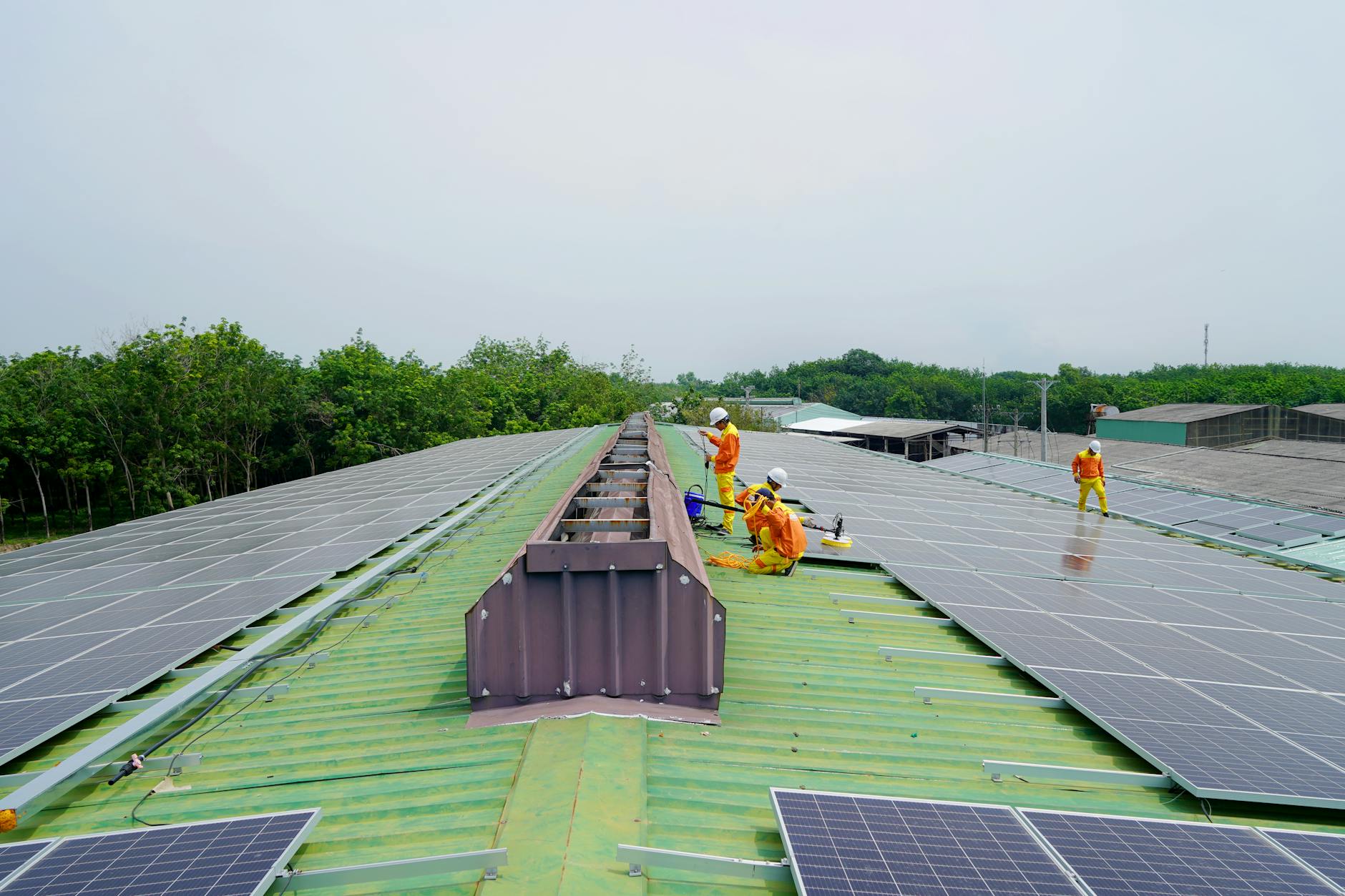
These industrial establishments have enormous rooftop areas — often 10,000-30,000 sq ft of unshaded metal sheet roofing — that can accommodate 50-200 kW or larger solar systems.
Residential Areas
Palladam's residential landscape includes:
- Town centre homes: Older construction along the main bazaar streets, with 1,000-2,000 sq ft plots and limited but usable terrace space of 400-800 sq ft
- New layouts and extensions: DTCP-approved residential layouts on the outskirts, particularly towards the Palladam-Tirupur road and Palladam-Coimbatore road, with plots of 1,500-3,000 sq ft and modern RCC construction
- Agricultural homesteads: Larger properties on the Palladam-Dharapuram and Palladam-Udumalpet roads with spacious grounds suitable for both rooftop and ground-mounted solar
Agricultural Properties
The Palladam taluk is one of Tirupur district's most productive agricultural zones:
- Coconut and banana plantations with agricultural pump sets running 6-10 hours daily
- Vegetable farms and flower cultivation using drip irrigation powered by electric motors
- Poultry farms in the outskirts with continuous lighting and ventilation loads
- Cold storage facilities for agricultural produce with high electricity consumption
TANGEDCO Procedures for Palladam
Palladam falls under the TANGEDCO Tirupur Distribution Circle.
Key TANGEDCO Offices
- Section Office: TANGEDCO Palladam Section Office, located near the Palladam bus stand
- Sub-Division: Palladam Sub-Division office
- Distribution Circle: Tirupur Electricity Distribution Circle (EDC)
- Superintending Engineer: Tirupur Region
Net Metering Process
- Application: Submit the net metering application at the Palladam section office with system design documents, vendor MNRE registration certificate, and property ownership proof
- Feasibility assessment: TANGEDCO engineers conduct a site inspection to verify transformer capacity and grid compatibility (15-25 days)
- Approval: Receive feasibility approval with any conditions (e.g., transformer upgrade if needed)
- Installation and commissioning: Complete the installation and submit test reports
- Net meter installation: TANGEDCO installs the bidirectional meter (30-60 days after commissioning)
Palladam-Specific Notes
- Palladam's grid infrastructure has been upgraded in recent years to support the industrial load — most distribution transformers can accommodate residential solar injection
- Cotton mills seeking large-scale (100 kW+) solar installations should engage with the Tirupur EDC directly for open access or captive power arrangements
- The Palladam section office handles a moderate volume of solar applications — having all documents ready accelerates the process
- Agricultural connections can apply for solar pump installations under the PM-KUSUM scheme through the Palladam section
Costs and Savings
Palladam Solar Generation Potential
| Parameter | Palladam, Tirupur | Tamil Nadu Average |
|---|---|---|
| Annual irradiance | 5.0-5.4 kWh/m2/day | 4.8-5.1 kWh/m2/day |
| Average daily generation per kWp | 4.2-4.5 units | 3.8-4.2 units |
| Annual generation per kWp | 1,530-1,640 units | 1,380-1,500 units |
| Monsoon impact (Oct-Dec) | Moderate (15-25% reduction) | Varies by region |
Palladam benefits from Tirupur district's semi-arid climate, with lower cloud cover and humidity than coastal Tamil Nadu, resulting in consistently higher solar output.
Residential System Costs and ROI
| System Size | Net Cost (after subsidy) | Monthly Generation | Monthly Savings | Payback Period |
|---|---|---|---|---|
| 3 kW | Rs 70,000-1,00,000 | 380-410 units | Rs 2,000-3,000 | 3-4 years |
| 5 kW | Rs 2,00,000-2,70,000 | 640-690 units | Rs 4,000-5,500 | 4-4.5 years |
| 8 kW | Rs 3,70,000-4,70,000 | 1,020-1,100 units | Rs 6,800-9,200 | 4-5 years |
| 10 kW | Rs 4,70,000-6,00,000 | 1,280-1,370 units | Rs 8,800-11,500 | 4-5 years |
Industrial System Costs (Without Subsidy)
| System Size | Approximate Cost | Monthly Generation | Monthly Savings (at Rs 8/unit) | Payback Period |
|---|---|---|---|---|
| 50 kW | Rs 23,00,000-28,00,000 | 6,400-6,800 units | Rs 51,200-54,400 | 4-5 years |
| 100 kW | Rs 42,00,000-50,00,000 | 12,800-13,700 units | Rs 1,02,400-1,09,600 | 3.5-4.5 years |
| 200 kW | Rs 80,00,000-96,00,000 | 25,600-27,400 units | Rs 2,04,800-2,19,200 | 3.5-4 years |
Typical Palladam Home Scenario
Scenario: Independent house in a new layout on Palladam-Tirupur road, G+1 construction, 2 split ACs, monthly consumption 450 units, 3 kW system
| Parameter | Value |
|---|---|
| Net cost after subsidy | Rs 85,000 |
| Monthly generation | 395 units |
| Monthly savings | Rs 2,400 |
| Annual savings | Rs 28,800 |
| Payback period | 3 years |
| 25-year savings | Rs 7.2 lakh |
Area-Specific Considerations
Cotton Mill Rooftop Installations
Palladam's cotton mills present unique solar opportunities and challenges:
- Roof structure: Most mills have truss-supported GI sheet roofs with long, uninterrupted spans — excellent for large arrays. However, older asbestos roofs in some mills require replacement before solar installation
- Vibration and structural loading: Spinning mills generate significant vibration from high-speed machinery. Mounting structures must be designed to absorb vibration without loosening over time
- Running hours advantage: Mills operating 24/7 consume electricity round the clock, meaning solar generation during the day directly offsets peak tariff consumption — maximising savings
- Captive power vs net metering: Mills consuming more than 1,00,000 units/month should evaluate captive solar power plants (ground-mounted, 500 kW-1 MW) rather than solely rooftop systems
Agricultural Solar Pumping
Palladam's agricultural belt offers strong potential for solar-powered irrigation:
- Farmers with 3-phase agricultural connections running 5-10 HP pump sets can install solar pump systems under the PM-KUSUM scheme with up to 60% subsidy
- Ground-mounted solar systems adjacent to bore wells eliminate dependency on erratic grid supply
- Solar pumps with VFD (Variable Frequency Drive) controllers optimise water output based on available sunlight
Dust and Cotton Fibre Accumulation
A challenge specific to Palladam is cotton fibre and lint from nearby ginning and spinning operations:
- Cotton fibre can accumulate on panel surfaces and reduce generation by 5-10% if not cleaned regularly
- Recommended cleaning frequency near cotton mills: Every 2 weeks during ginning season (October-March)
- Automated panel cleaning systems (robotic cleaners) may be justified for large industrial installations
Weather Patterns
Palladam receives an average annual rainfall of 600-700 mm, primarily from the northeast monsoon:
- Dry season (January-May) delivers peak generation, coinciding with the hottest months when electricity demand is highest
- Summer temperatures reaching 37-39 degrees Celsius cause a minor efficiency reduction (about 0.4% per degree above 25 degrees Celsius), partially offset by the higher irradiance
- Low humidity and minimal fog make Palladam an excellent year-round solar location
Palladam Landmarks and Context
- Palladam Bus Stand area: Town centre with commercial shops — rooftop solar on commercial buildings reduces electricity costs on commercial tariff
- Palladam-Tirupur Road: The main connectivity corridor with new residential and commercial developments on both sides
- Palladam Industrial Area: Concentration of cotton mills and textile units — priority area for industrial solar adoption
- Periyar Memorial area: Residential zone with a mix of old and new homes suitable for 3-5 kW systems
- Palladam-Dharapuram Road: Agricultural corridor with farmhouses and agricultural properties ideal for ground-mounted solar
Next Steps for Palladam Residents and Business Owners
Palladam's cotton mills, growing residential areas, and productive agricultural belt make it a high-potential location for solar energy in Tirupur district. Whether you run a spinning mill with monthly electricity bills exceeding Rs 10 lakh or own a home with a bill of Rs 2,000-4,000, solar power delivers strong returns.
- Calculate your savings with our online tool — enter your monthly consumption for an instant estimate
- Request a free site assessment — our Tirupur district team will evaluate your roof or land, assess structural suitability, and provide a detailed proposal
- Start saving: With payback periods as short as 3 years for residential systems, the sooner you install, the sooner you benefit
Tristar has a dedicated team in the Tirupur-Coimbatore region with experience in both residential and industrial solar installations. We handle everything from system design to TANGEDCO Tirupur net metering approval.
Ready to Go Solar?
Get a personalized solar quote based on your electricity consumption and roof area.
Related Articles
Solar Installation in Kangeyam | Tirupur Agri Guide
Kangeyam is an agricultural town in Tirupur district famous for the Kangeyam cattle breed and dairy farming. Learn about solar installation for farms, dairy operations, and homes, TANGEDCO procedures, and savings.
Solar Installation in Udumalpet | Tirupur Agri Guide
Udumalpet sits in Tirupur district's agricultural belt near the Anamalai Hills with strong off-grid solar potential. Learn about solar installation for farms, homes, and rural properties, TANGEDCO procedures, and savings.
Solar Installation in Annur | Coimbatore Rural Guide
Annur is a semi-urban town near Karamadai on the northern outskirts of Coimbatore district with agricultural and residential properties. Learn about solar installation costs, TANGEDCO procedures, and savings.